Sustainable
made
Reliable


Walmart just switched on its 100th fast-charging site, with stalls that push up to 400 kW and a plan to reach thousands of stores by 2030. That is good news for anyone who drives an EV. Then the headlines took it a step further: retail fast charging, we were told, is the answer for apartment renters who cannot charge at home.
I have lived that "answer." I drove an EV for years with a charger in my garage. In 2022 I moved into a Chicago apartment and lost it overnight. My car did not change. My life did. I started planning grocery runs around chargers, checking apps before bed, and doing math about state of charge at 11 p.m. in a parking lot. It worked, in the way that eating every meal at a restaurant works. It is possible. It is not a plan.
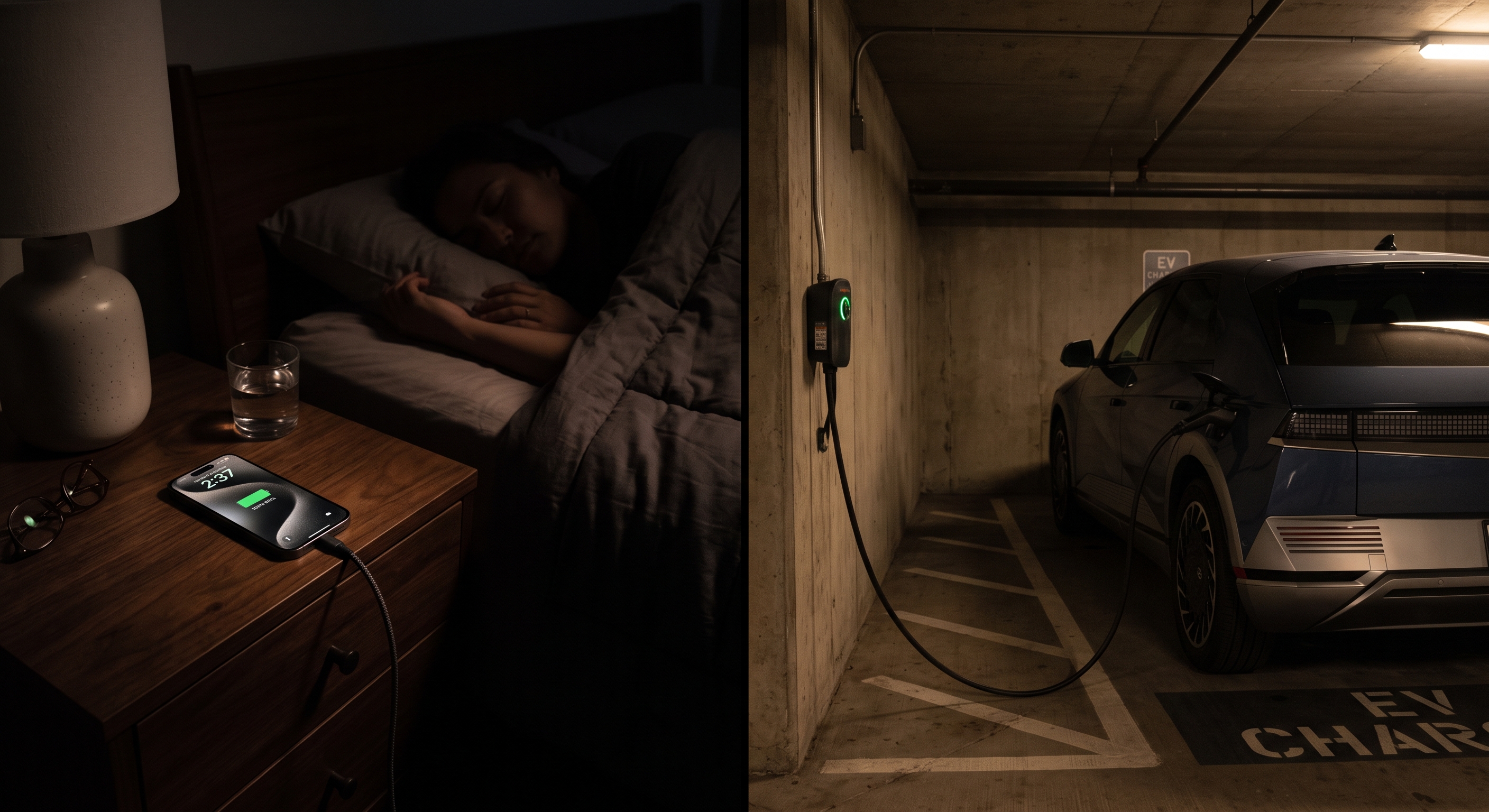
Here is a simpler way to think about it. You do not charge your phone at Starbucks. You plug it in at night and wake up to a full battery. Your car wants the same deal, and if you own a house with a garage, you already have it. If you rent, you probably don't. That is the whole problem.
How EV owners actually charge
The numbers are not close. According to J.D. Power's 2026 home charging study, 86% of typical EV charging happens at home. Drivers who have a plug where they park do not think about charging. They park, plug in, and walk away. Charging becomes a habit instead of an errand, and that is the real reason EV owners with home charging say they would never go back.
Public charging exists for everyone else, and for everyone on a road trip. Walmart, Tesla, Ionna and the rest are doing valuable work. But look at where the industry itself says public charging fits: the highway, the emergency top-up, the day you forgot to plug in. That is a backup. Nobody designs a network for the 100 miles you drive every week to the office and back.
What public charging is great at
To be fair to the fast chargers, they are perfect for a specific list of jobs:
- Road trips. A 20-minute stop every few hours is exactly what 400 kW is for.
- The occasional emergency. You forgot, the weather turned, the kid has a game across town.
- Bridging a gap. You just bought the car and your charging setup is not ready yet.
The mistake is not building public chargers. The mistake is telling people who rent that public charging is their permanent home charger.
Why public charging fails as a daily driver
The detour tax. Even a charger "just two miles away" is not two miles. It is five minutes there, five minutes back, thirty minutes on the plug, and five minutes of app, card and cable. Call it 45 minutes a session. Twice a week and you have handed over about 78 hours a year, roughly two full work weeks, to something homeowners do while they sleep.
The line. Public chargers are shared by design. Arrive at the wrong time and every stall is taken, or one of them is broken. J.D. Power reports that public fast chargers still fail drivers on 12% of visits, and that is the best number in the six years they have tracked it. A charger at your own parking space is never occupied by someone else.
The price is not yours to control. Fast chargers pay utilities "demand charges" based on the peak power they pull, not just the energy they use. The Great Plains Institute found that at 350 kW, demand charges make up 68 to 81% of a station's total cost. Walmart's stalls run to 400 kW. A retailer can afford to price charging as a reason to walk into the store, at least for now. But the underlying math is exposed to peak power costs, and the industry will not subsidize your daily commute forever. Level 2 charging at your building is the opposite kind of load: a small, steady draw overnight, when the grid is quietest. It is a boring cost structure, which is exactly what you want from something you use every day.
Weather and late nights. The cheapest public rates are off-peak, which means late evening. That is also when you least want to spend 40 minutes in an open parking lot, in January, in Chicago. A charger at your building does its work at exactly those hours, while you are upstairs asleep.
Outlet brain. This is the cost nobody puts in a spreadsheet. When you depend on public charging, every plan starts with a battery percentage. Can I take the long way? Should I charge tonight or tomorrow? The freedom that makes an EV great disappears, and what is left is a car that needs managing.
The renter's trap
This is where the data gets uncomfortable. A UC Davis study published in Nature Energy followed 4,160 California EV buyers and found that roughly one in five went back to gasoline. The people who quit were disproportionately renters, apartment dwellers, and drivers who could not install Level 2 charging at home. They did not stop believing in EVs. They ran out of patience with charging away from home.
The people who never buy in the first place tell the same story. In J.D. Power's 2026 EV Consideration Study, 25% of new-vehicle shoppers say they are very likely to consider an EV. Among apartment residents, that number is 18%, and it fell this year while the overall number rose. J.D. Power's own read: consideration among shoppers who cannot charge at home or work "has barely moved, highlighting a critical gap in multifamily and workplace infrastructure."
So the retail charging story is backwards. Fast chargers at the store will not turn renters into EV owners. Charging where they sleep will.
What renters actually need
Apartment residents do not need a faster charger across town. They need a slower one at home. A Level 2 charger at their own parking space delivers a full battery every morning, with no line and no detour. This is the charging setup that 86% of EV owners already enjoy, and it is the one most apartment buildings still cannot offer.
Which raises the obvious question: if renters want it this badly, why don't more buildings have it? It is not for lack of demand. The National Multifamily Housing Council's renter preferences survey found 27% of renters would pay more each month for EV charging, and EV drivers tend to be exactly the residents a building wants to keep: longer-tenured, higher-income, and increasingly choosing between the building that has a plug and the one that does not. What they are buying is not a charger. It is the end of outlet brain.
The real reason is the check. Most owners have never been shown a way to add charging without funding hardware, electrical work, and years of operations out of pocket. That is the gap Ampable exists to close. We fund, install, and operate Level 2 charging at multifamily buildings. Owners pay nothing for hardware or breaker-to-charger installation and carry no operating burden. Residents pay only for the electricity they use, with no subscription and no parking premium. We earn a share of the energy delivered and nothing else, so if a charger stops working, our revenue stops with it. Owners can see every session, every kilowatt-hour and every dollar in the Ampable Console.
If you rent, ask your building whether home charging is on the roadmap. If you own or manage one with parking and residents who drive, we should talk. The buildings that add home charging first will lease the EV drivers. The ones that wait will lease to whoever is left.
Sources: Walmart corporate newsroom, Aug. 21, 2026; J.D. Power 2026 U.S. EVX Home Charging Study, 2026 EVX Public Charging Study, and 2026 EV Consideration Study; Great Plains Institute, "How Demand Charges Impact EV Fast Charging Infrastructure"; Hardman and Tal, Nature Energy (UC Davis); NMHC and Grace Hill Renter Preferences Survey.